
PROJECT CASE

Guangda Electric Is A Professional Organization Dedicated To Solving Power Quality Problems Of Users

Qinhuangdao Boye Glass Co., Ltd.


Time:

2019-01-05

Typical Case of Harmonic Control in Glass Factory (Qinhuangdao Boye Glass Co., Ltd.) Project Background: A certain glass 10kV distribution station currently has one transformer with a capacity of 1000kVA, 10kV/0.4kV. The main electrical load is general AC loads, with a high-power variable frequency drive used only during the air-cooled cooling of the glass. After the glass is output from the tempering furnace, the fan starts to operate, and this process continues in a cycle. During the operation of the fan, the current distortion in the power grid is very high. Control Plan: Based on the comprehensive consideration of on-site test data, an active power filter model SPA3-100/0.4 was selected.
Typical Case of Harmonic Control in Glass Factory (Qinhuangdao Boye Glass Co., Ltd.)
Project Background:
A certain glass 10kV distribution station currently has one transformer with a capacity of 1000kVA, 10kV/0.4kV; the main electrical load is general AC load, only using a high-power frequency converter when cooling the glass with air. After the glass is output from the tempering furnace, the fan starts to work, and this working process continues to cycle. During the operation of the fan, the current distortion in the power grid is very high.
Control Scheme:
Based on comprehensive consideration of on-site test data, an active power filter model SPA3-100/0.4 is selected to compensate for the harmonics in the power grid, which can effectively achieve the purpose of harmonic control.
Control Effect:
GoodPower
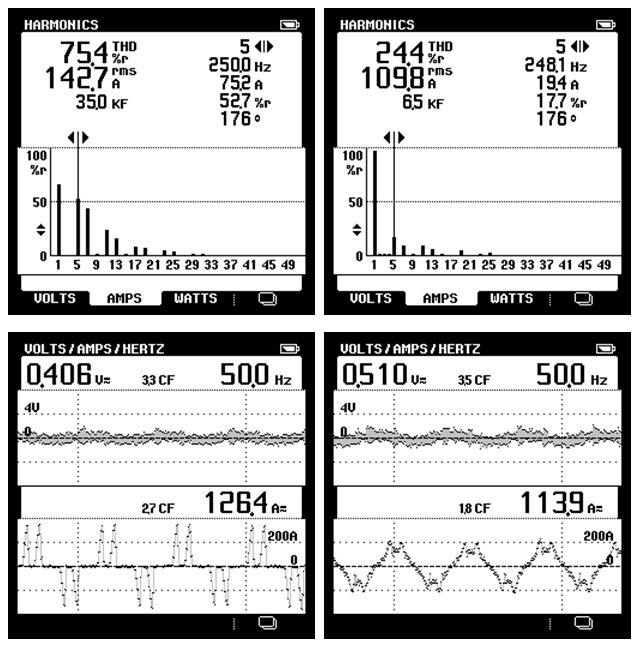
As can be seen from the figure, the harmonic current in the power grid was very large before the filter was put into operation, with the total harmonic current distortion rate reaching a maximum of 75.8%, and the waveform of the power grid current was also severely distorted. In contrast, after the filter was put into operation, the total harmonic current distortion rate has been reduced to a minimum of 24.4%, and the waveform of the power grid current is closer to a sine wave than before, effectively improving the power quality of the grid.