
Four-quadrant reactive power compensation controller for photovoltaic systems
The MCGD‑G can monitor reactive power and voltage fluctuations in the grid in real time. By adjusting the reactive power output of the photovoltaic system, it achieves reactive power compensation, thereby enhancing grid stability and power quality. At the same time, it intelligently regulates the active power output of the photovoltaic system based on solar irradiance conditions and grid demand, enabling maximum power point tracking and optimized energy utilization.
Category:
- Summary
- Product Selection
- Distinction
- Parameter
- Explain
- Size
-
- Commodity name: Four-quadrant reactive power compensation controller for photovoltaic systems
The MCGD‑G can monitor reactive power and voltage fluctuations in the grid in real time. By adjusting the reactive power output of the photovoltaic system, it achieves reactive power compensation, thereby enhancing grid stability and power quality. At the same time, it intelligently regulates the active power output of the photovoltaic system based on solar irradiance conditions and grid demand, enabling maximum power point tracking and optimized energy utilization.
The MCGD‑G can monitor reactive power and voltage fluctuations in the grid in real time. By adjusting the reactive power output of the photovoltaic system, it achieves reactive power compensation, thereby enhancing grid stability and power quality. At the same time, it intelligently regulates the active power output of the photovoltaic system based on solar irradiance conditions and grid demand, enabling maximum power point tracking and optimized energy utilization.
Product Features:
► As long as the wiring phase sequence is correct, no parameter settings are required—intelligent compensation control is enabled.
► Controlled physical quantity: reactive power + Target power factor, avoiding compensation dead zones and preventing switching oscillations.
► Automatic phase sequence identification: secondary wiring terminals of the current transformer S1 and S2 Interchangeable; voltage wire L2 and L3 They can also be interchanged. Once the phase sequence controller is powered on, it will automatically correct any wiring errors; alternatively, you can use the controller’s operation buttons to make corrections manually.
► The display offers a wide range of functions, showing four-quadrant power, various electrical parameters, waveforms, harmonic bar graphs, temperature, operating hours, monthly average power factor, and more.
► The protection functions are comprehensive, including overvoltage, undervoltage, voltage harmonic exceedance, temperature overlimit, low‑load alarm, and insufficient compensation capacity alarm, among others.
► Superior anti-interference capability, EMC Electromagnetic Compatibility Testing: EFT Group pulse interference resistance reaches 4000V of the A Level ( IEC (The highest level of the standard.)
Technical Specifications:
1) Applicable Standards: JB/T 9663-2013 and DL/T 597-1996.
2 ) Power supply: AC 85V~265V or DC 120V~370V , with independent power supply.
3 ) Sampling voltage input: AC 100V ~ 750V , 50 Hz or 60Hz。
4 ) Sampling current input: AC 0 ~ 5A , or 0–1 A (please specify when ordering).
6) Controlled physical quantity: reactive power; the C/K value takes into account the power factor.
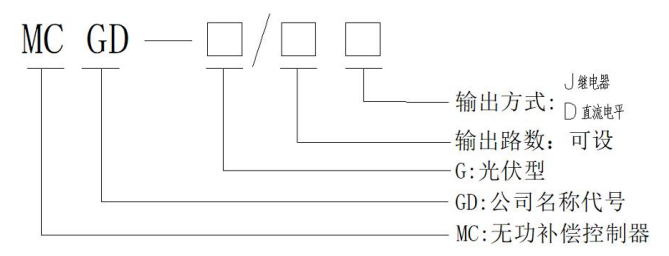
7) Controller output type: Dynamic—contactless—Type D: DC 12 V/50 mA; Static—with contacts—Type J: 2 A/250 VAC.
8 ) Control object: MCGD-**D , a dynamic controller that regulates thyristor switches or composite switches; MCGD-**J , a static controller that controls an AC contactor.
9 ) Dynamic response time: dynamic D Type ≤ 20 Millisecond
10 ) Sensitivity: ≥ 20mA
11 ) Measurement accuracy: Voltage: 0.5 level
Current: 0.5 level
Power factor: 0.5 level
Active power: 1.0 level
Reactive power: 2.0 level
Frequency: 0.5 level
Temperature: 0.5 degree
12 ) Device power consumption: MCGD- □□ D ≤ 10VA; MCGD- □□ J ≤ 20VA
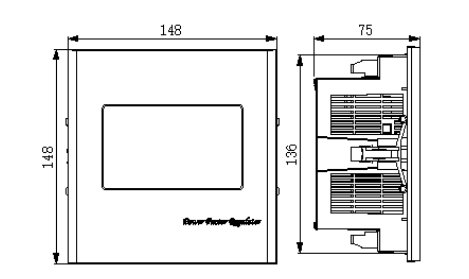
13 ) External dimensions: 148 × 148 × 75mm
14 ) Installation hole dimensions: 138 × 138mm
Specification and Model Description:

Product Selection:
Product Dimensions Diagram:
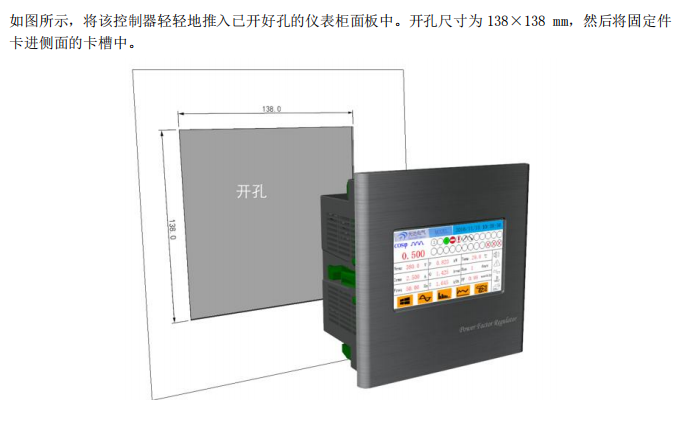 Key words:
- Four-quadrant reactive power compensation controller
- photovoltaic-specific four-quadrant compensation controller
-

-
► As long as the wiring phase sequence is correct, no parameter settings are required—intelligent compensation control is enabled.
► Controlled physical quantity: reactive power + Target power factor, avoiding compensation dead zones and preventing switching oscillations.
► Automatic phase sequence identification: secondary wiring terminals of the current transformer S1 and S2 Interchangeable; voltage wire L2 and L3 They can also be interchanged. Once the phase sequence controller is powered on, it will automatically correct any wiring errors; alternatively, you can use the controller’s operation buttons to make corrections manually.
► The display offers a wide range of functions, showing four-quadrant power, various electrical parameters, waveforms, harmonic bar graphs, temperature, operating hours, monthly average power factor, and more.
► The protection functions are comprehensive, including overvoltage, undervoltage, voltage harmonic exceedance, temperature overlimit, low-load alarm, and insufficient compensation capacity alarm, among others.
► Superior anti-interference capability, EMC Electromagnetic Compatibility Testing: EFT Group pulse interference resistance reaches 4000V of the A Level ( IEC (The highest level of the standard.)
-
1) Applicable Standards: JB/T 9663-2013 and DL/T 597-1996.
2 ) Power supply: AC 85V~265V or DC 120V~370V , with independent power supply.
3 ) Sampling voltage input: AC 100V ~ 750V , 50 Hz or 60Hz。
4 ) Sampling current input: AC 0 ~ 5A , or 0–1 A (please specify when ordering).
6) Controlled physical quantity: reactive power; the C/K value takes into account the power factor.
7) Controller output type: Dynamic—contactless—Type D: DC 12 V/50 mA; Static—contact—Type J: 2 A/250 VAC.
8 ) Control object: MCGD-**D , a dynamic controller that regulates thyristor switches or composite switches; MCGD-**J , a static controller that controls an AC contactor.
9 ) Dynamic response time: dynamic D Type ≤ 20 Millisecond
10 ) Sensitivity: ≥ 20mA
11 ) Measurement accuracy: Voltage: 0.5 level
Current: 0.5 level
Power factor: 0.5 level
Active power: 1.0 level
Reactive power: 2.0 level
Frequency: 0.5 level
Temperature: 0.5 degree
12 ) Device power consumption: MCGD- □□ D ≤ 10VA; MCGD- □□ J ≤ 20VA
13 ) External dimensions: 148 × 148 × 75mm
14 ) Installation hole dimensions: 138 × 138mm
-

-

RELATED PRODUCTS
Fast-acting vacuum circuit breaker
Power Quality Online Monitoring Device
Four-quadrant reactive power compensation controller for photovoltaic systems
Wall-Mounted Active Power Filter Compensation Module
PRODUCT MESSAGE
Follow Us
Guangdong Guangda Electric Co. Ltd.
Tel:18028173868
E-mail:gdgddq@126.com
Web:www.gd96.com
Add :Building 3, No. 613, Xingtan Shuixiang Avenue, Gaozan Village, Xingtan Town, Shunde District, Foshan City, Guangdong Province